Thursday, June 19, 2008

Chapter 4

Christians in America need to get over their insatiable hunger for persecution stories, and we in the house churches must get over our persecution complex. Yes, there has been persecution in this city's past, but our greatest need is not eliminating persecution but building up mature fellowship and developing unity among Christians."

Beijing House Church Pastor, 2006

What a wonderful and apt quote from this Beijing House Church pastor! I think it sets the stage for this whole chapter. First things first! I must state this disclaimer…. I do not believe that there is no persecution of Christians in China. I know and believe that there are Christians today who are suffering for their faith. As you just read in this chapter, my intention is to help the church in the West to refocus its attention off of the persecution of Christians in China and on to the much bigger story in China, which is the growth of the Chinese church and its increasing influence in China. It is becoming widely accepted that persecution is not the main story of Christianity in China today and it is my contention that many in the West have a hard time letting go. But it is when we let go that we see China with new eyes and we see how we can best engage with what God is doing. As another example of this, Christianity Today recently had a wonderful article in its May 2008 issue called ‘Great Leap Forward,’ about Chinese Christians. In the article, they told a story about Job, a new convert in Beijing who started a Bible Study in his home. The Bible Study quickly grew to 100 people and from this study, they started a ‘House Church.’ Upon starting the House church, he quickly engaged with local Government officials. Here is a small excerpt from the article:

Job was accustomed to working with government officials, security officers, and other influential people in his city of 7.8 million people. As a doctor, he regularly treated local Party officers. He saw no need for his church to meet clandestinely. Rather, Job met with officials monthly, keeping them informed of the church's activities, even inviting them to Christmas and Easter services. Job and his wife now rent office space and do not hide the fact that it's for church services.

Job is consciously avoiding the traditional approach that unregistered house churches once used. "The old house-church movement's relationship with the government is confrontational," he says. "We are looking at coexisting. For them to ask anything of us, we will look at it, and if it's proper, we will do our best to cooperate." Last Christmas, Job's church, together with urban house churches across China, worked with local officials to deliver "parcels of love" to needy families.

It's a strategic gesture, a great leap forward for Christians eager to express God's love for their neighbors. "Government acceptance of us depends on our community contribution," says one pastor.1

If persecution was as widespread as some people would have you think, do you think Job would have had this interest and success in engaging with government leaders? Aren’t the government leaders the ones who are supposed to be persecuting? I would highly encourage you all to read this article, which can be found here.

I had two other intentions in writing this chapter. I wanted to use this chapter as another ‘call to action’ for more responsible reporting on stories on China. I’d be interested to read on this blog of other stories you may have about hearing only half the story. I also have had a long standing approach to those who are suffering persecution that while its hard to go through persecution, it is clear in Scripture that God also uses it for His purposes in our lives. And if that is the case, why do we get so upset with the Chinese government when they do persecute? After all, isn’t the current massive growth of the Chinese church the fruit of the persecution of the 1950’s, 60’s, and 70’s? Interested to read your thoughts!

  1. http://www.christianitytoday.com/ct/2008/may/19.22.html

Chapter 3

In this chapter of the book, I really had two purposes in writing the chapter. The story about the Togolese of course was a fictional story, but I hope it made you think about what it would be like for Christians from another culture to come into our world here in the West and treat us like we often times treat the Chinese. I’m hoping to hear from many of you in this blog of what you thought about that exercise and what feelings it induced. Increasingly, I’m talking to Chinese pastors who are having very mixed feelings about short-term teams from the West coming to China. On one hand, they want to be very accommodating to their Western brothers and sisters in Christ. On the other hand, these pastors are crazy busy with their work in ministry and they feel that the short-term teams add little benefit to their ministry. I hope the story of the Togolese also will help foster conversations in the West about how we can most effectively engage with Chinese Christians, coming to China not assuming our way is best.

Secondly, I hope that the rest of the chapter gives you all many more ‘pieces of the puzzle.’ These pieces deal both with current changes in China and how we see them (like the development of rule of law), and how we as Westerners engage in China. I certainly hope that it was beneficial to bounce these ideas around, both in your own mind and with others that you may be reading the book with.

Comments, questions or concerns about this chapter are welcome in this space. Looking forward to hearing from you!

Monday, June 9, 2008

Chapter 2

The changes that have happened in China over the last 20 years have had at least two characteristics: First, they’ve come at us fast. In fact, they’ve come at us so fast that it has been easy to miss the changes that have happened in China. Secondly, the changes in China have been deep, wholesale changes in almost every sector of society. Of course, we know about the changes that have been made in the economic sector that has fueled this remarkable economic growth, but there are many other areas of change. When we uncover them, I think it really helps us with many pieces to our overall picture of China and her Church.

As an example of this, I met an older couple yesterday that had just finished a three-week tour of China, their first trip to China. The older gentleman told me that before leaving for the trip, he had in his mind that China was a police state and he was expecting armed military personnel on every corner in the cities of China. What he found, of course, is a complete opposite picture of what he thought he would find in China. And this is a main point for me: That so many in the West have a picture of China in their minds that doesn’t come close to meeting reality. Of course, it is not really their fault in that we in the West automatically have a picture in our minds when it comes to the word “Communist.” I’ve taken the task of changing these perceptions as a personal crusade of mine. So here’s my main points from Chapter 2:

  • The changes in China have been deep and have happened quickly.
  • There is a clear road map that we can trace to see the development these changes have taken.
  • It is our responsibility in the West to keep up with these changes and use our analysis to effect our engagement in China.
  • In areas like Rule of Law, showing patience to the Chinese helps us develop relationships and gives us the opportunity to be ‘Jesus with skin on.’
  • By understanding that China is undergoing a transition from a secular state to a religious state gives us hope for China’s future and helps us engage appropriately.
  • Because Chinese intellectuals are increasingly seeing Christianity as the answer for China’s ills allows us to engage with them in ways that only proves to them that they are right.


So now it’s your turn! What do you think about Chapter 2? And what other changes and trends have you seen that would help us all understand China and her Church? I turn the floor over to you!

Wednesday, June 4, 2008

Chapter 1

Well, if you’re reading this posting, you’ve most likely starting reading my book. Let me first thank you for picking up a copy and reading the book. I hope you’re enjoying reading it as much as I enjoyed writing it. May I encourage you at some point once you are done with the book to give your feedback on the book’s Amazon.com page found here. It will help me get the book into the hands of more people and all the proceeds from the sale of the book go back into the China Resource Center!

So, let’s revisit Chapter 1. There are two main reasons that I thought it would be good to start the book with Chinese history. First of all, I thought that bringing to light the ‘other side’ of the story of the 19th Century missionaries would bring some pieces of the puzzle to the Western reader. In doing the research for this chapter, an interesting scenario took place. As I began to learn more about many of the missionaries’ attitudes towards the Chinese they were trying to reach with the Gospel, it made me upset that they would be so condescending towards the Chinese. I began to email and call other China researchers that I know about the situation and we all agreed that it really was a situation of the ‘good, bad and the ugly’ of the 19th Century. During the time that I’ve been involved with China, I’ve always been perplexed why when Chinese governmental officials would talk in speeches or interviews about religion in China, they would always warn the Chinese people to be aware of ‘foreign aggression.’ It just never made sense to me until I began reading 19th Century Chinese history. There are many in the West who have just thought that this tie with ‘foreign aggressors’ has been a way to subvert religion in China. Certainly over the course of the last 50 years, I’m sure that has occurred to some degree. But I think that we see through the course of 19th Century Chinese history that in the minds of Chinese, they don’t forget what you’ve just read in Chapter 1. It is also interesting to me how clearly we see God’s providence throughout the 19th Century. Despite mistakes that many Western missionaries made during their time serving in China, God’s will for the Chinese continued to come through and it was the effort of these missionaries that laid the foundation for the rapid growth of the Chinese church that we’ve seen over the last 50 years. What an interesting period of history to study because we really do see it all. So here are the questions I’ll pose to you all: I’m interested to know if after reading this chapter, you gained more understanding about how many Chinese think about Christianity. Also, I’m interested to know if this aspect of Chinese history is new to you, or if you already knew about the attitudes of some Christian missionaries of the 19th Century.

The second reason to recall this history is that I think there is a lot we can learn even today as we engage with China. Even today, it is easy for us as Westerners to think that we have ‘the best’ ways to do evangelism, Bible study, discipleship, etc. And while we certainly have something to add in the equation, as you’ll learn in Chapter 3, the Chinese bring a very unique and different culture to the table that doesn’t always mesh with our methods and our patterns of ministry. You will see throughout the course of the book that I highly value the need for us as Westerners to come into China as learners first and adapt ourselves to the Chinese culture and situation rather than the other way around. So what thoughts to you all have about that?

Monday, June 2, 2008

Starting the Online Content


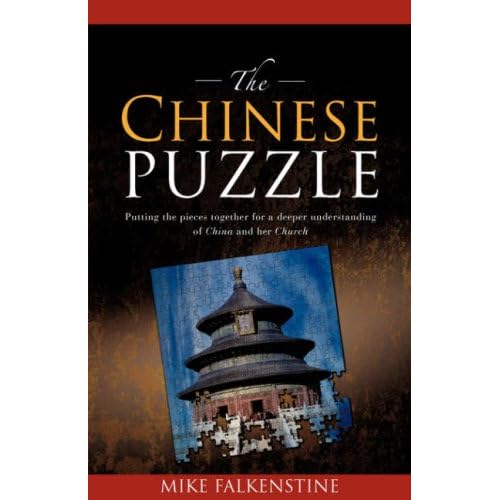
Wow! I just received the first copies of the book from the publisher and it looks great! I really excited about starting the online content of the book. Here's the basic idea: Once you've started reading the book, you will have the opportunity to add your thoughts and comments about the content of each chapters. You'll also have the opportunity to read more from me, including why I included certain parts of the book, why I didn't touch on other subjects, etc. I will have a seperate blog posting for each of the chapters, so you may need to scroll through just a bit to find the chapter that you want to comment on. Looking forward to going through this journey with many of you!